

Expert Advice on Building an Effective Multi-Asset Portfolio

Share

How can investors create an effective multi-asset investment strategy amidst market volatility? This question has been on the minds of discerning investors looking to weather the storm during volatile times.


“An effective multi-asset strategy is about selecting a combination of different assets that can best sustainably protect and grow a portfolio under various market conditions over a target time horizon and desired risk tolerance,” explains WMI’s faculty member Dr Aaron Low, CEO of wealth platform Lumiq.


“Traditionally, these asset classes can include equities (stocks), fixed-income securities such as bonds, real estate investment trusts (REITs), commodities, and alternative investments – such as hedge funds, private equity, venture capital, and on.”


Prior to heading Lumiq, Aaron was Head of Asia Ex-Japan at PIMCO, where he oversaw Asia investment strategies and managed global and emerging market bond portfolios. He was also the global Chairman of the Board of Governors of CFA Institute. Based on his wealth of experience, including his previous role as Head of Investments, Asia, at Allianz GI, he shares with us some strategies to navigate market volatility and build a resilient portfolio.


Aaron explains that it “involves diversification across various asset classes, including both liquid transparent public markets and alternative assets, to reduce risk and capture growth from different economic sectors and geographical areas.”


The allocation to each asset class within the portfolio may vary based on factors such as investment goals, risk tolerance, time horizon, and market conditions. For example, in response to the prevailing expectation among most family offices of sustained positive US real interest rates, the allocation to developed market bonds increased to 16% in 2023 from 12% in 2022, according to UBS Global Family Office Report 2024.


However, the core theme is ties back to diversification; reducing overall risk and potentially improving returns by spreading investments across different asset classes that may perform differently under various market conditions. Family offices are looking beyond traditional asset classes, such as private equity and venture capital, toward other types of alternatives. Private debt grew from 8.3 per cent of family office fund searches in 2022 to 12.4 per cent in 2023, hedge funds from 5 per cent to 10.7 per cent, real estate from 13.2 per cent to 18.4 per cent, and infrastructure from 1.7 to 3.2 per cent, a Preqin Report reveals.


Aaron believes that when building a multi-asset portfolio, adaptability, picking quality investments, and having a long-term perspective would provide longevity and increase opportunities for returns. Here are his recommendations:


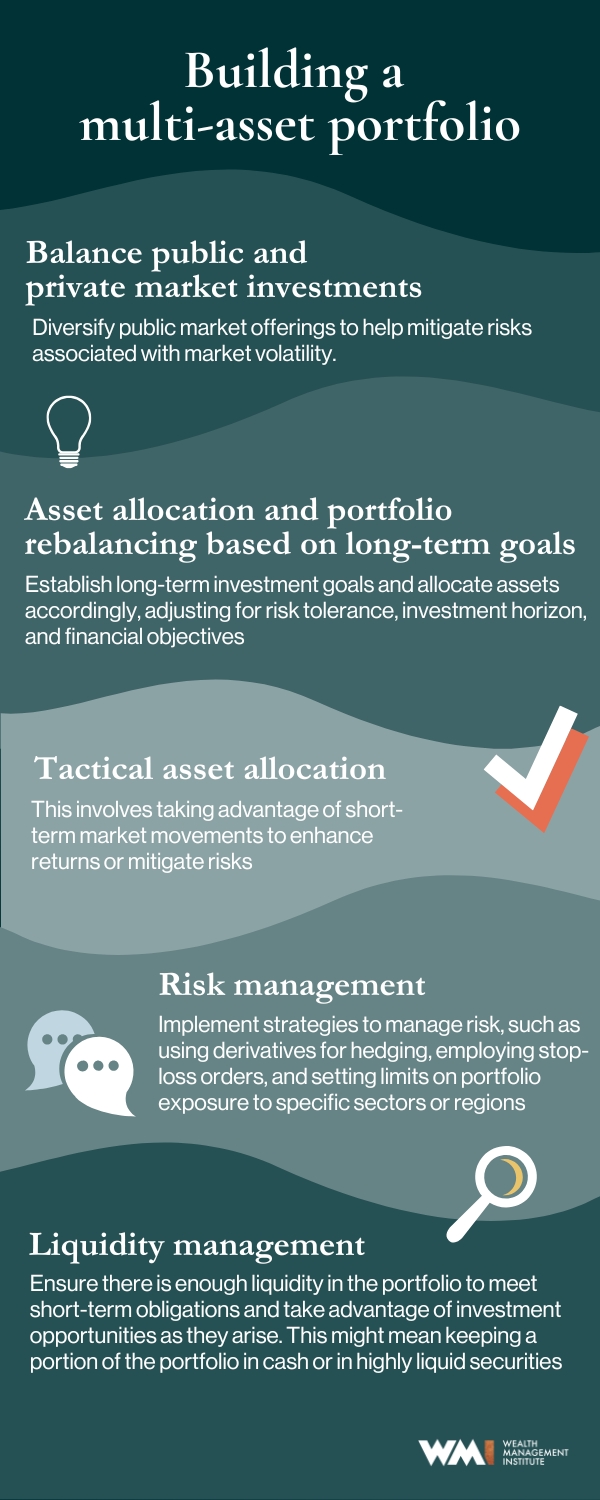
  • Balance public and private market investments to mitigate volatility risks
    Diversify public market offerings such as stocks, bonds, and commodities to help mitigate risks associated with market volatility. It’s crucial to balance between equities for growth and fixed-income securities for stability. At the same time, investments in private equity, private debt, real estate, and infrastructure should be added to offer higher potential returns and lower correlation with public markets, providing a cushion during periods of volatility.
  • Asset allocation and portfolio rebalancing based on long-term goals
    Establish long-term investment goals and allocate assets accordingly, adjusting for risk tolerance, investment horizon, and financial objectives. This strategy involves periodically rebalancing the portfolio to optimise the desired asset allocation.
  • Tactical asset allocation
    This involves taking advantage of short-term market movements to enhance returns or mitigate risks. It requires a more active management approach, adjusting exposures to different asset classes based on market conditions and forecasts.
  • Risk management
    Implement strategies to manage risk, such as using derivatives for hedging, employing stop-loss orders, and setting limits on portfolio exposure to specific sectors or regions.
  • Liquidity management
    Ensure there is enough liquidity in the portfolio to meet short-term obligations and take advantage of investment opportunities as they arise. This might mean keeping a portion of the portfolio in cash or in highly liquid securities.


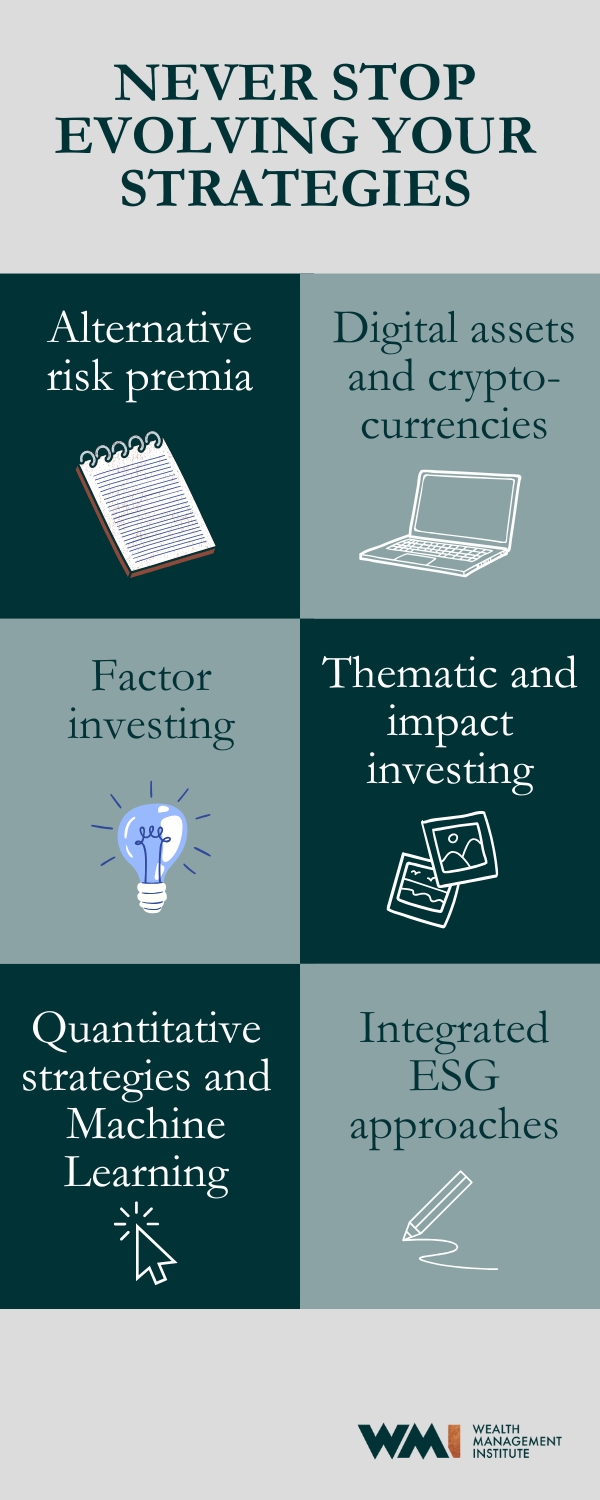
Never stop evolving your strategies

Aaron also recommends proactive learning and research to elevate multi-asset portfolios. “By embracing new markets, technologies, and analytical methods, investors can construct more resilient multi-asset portfolios capable of navigating complex market environments,” he said. Some of his newer themes include:


  • Factor investing
    Factor investing involves targeting specific drivers of return across asset classes, such as value, momentum, size, and quality to break out of traditional categorisation.
  • Alternative risk premia
    This approach seeks to capture returns from a broad range of risk premia beyond traditional equity and fixed income markets. It includes strategies like volatility harvesting, merger arbitrage, and trend following; with an aim to provide uncorrelated returns.
  • Digital assets and cryptocurrencies
    Incorporating digital assets such as cryptocurrencies into a multi-asset portfolio can offer a new dimension of diversification. Their volatility and low correlation with traditional assets, though risky, can be an unexpected buffer in some crises.
  • Thematic and impact investing
    Investing in themes or impact-driven opportunities, such as sustainable energy, technology advancements, healthcare innovation, and social governance factors, can provide growth opportunities.
  • Quantitative strategies and Machine Learning
    Using advanced quantitative strategies and machine learning algorithms can help identify non-obvious correlations, diversification opportunities, while managing risks across a global investment set.
  • Integrated ESG approaches
    Incorporating Environmental, Social, and Governance (ESG) criteria into investment analysis and decisions across all asset classes. This not only addresses risk management from a broader perspective but also aligns investments with longer-term sustainability trends.


Overcoming challenges to a successful multi-asset portfolio

According to Aaron, the top themes to watch for are changes in market regimes in risks (market volatility) and contagion (asset correlation) from geo-political uncertainties, monetary policy shifts. and AI impact. He suggests expanding diversification and “consider using derivatives for hedging against short-term risks”, while also adding non-traditional asset classes to lower the risk of the latter.


He also highlights liquidity concerns with certain assets, which can affect strategy mobility and that with a more dynamic portfolio, one may also face higher fees in active monitoring and maintenance. Shifting regulatory and tax responsibilities may also add to the consideration of which assets to work with.


The good news is that some of the challenges can fortify your strategies as well. With the evolution and improvement technology, innovation and data analysis that can help with better portfolio management, while driving positive trends in certain assets.


Conclusion

To sum up, having an agile approach to asset management is the most nimble way to navigate uncertain waters. Whether you are an asset allocator, portfolio manager, investment specialist, wealth advisor or family office professional, WMI’s Certificate in Multi-Asset Investing will enrich financial investors with established yet forward-looking strategies from an expert faculty.


“The goal is to construct a portfolio that is not only aligned with the investor’s risk tolerance and investment objectives but also resilient against market turbulence and capable of delivering consistent long-term returns,” he adds.


Learn more about WMI’s Certificate in Multi-Asset Investing

Related Article

Philanthropy, ESG & Social Impact

The Rockefeller Family and Peking Union Medical College:
A Century of Philanthropic Impact
洛克菲勒家族与协和医学院:
跨越百年的公益影响力

Programme Overview


【Chinese version below| 请见下方中文内容。】


When family legacy is discussed, attention often centres on how wealth, business ownership and control can be transferred smoothly from one generation to the next.


For many families, however, legacy is not only about the assets they preserve. It is also about the long-term value they hope to create for society. Enduring family influence often comes from translating resources, values and purpose into institutions and initiatives that can evolve, endure and serve needs beyond the family itself.


The development of Peking Union Medical College (PUMC) offers a meaningful historical example.


In the early twentieth century, China was entering an important period in the development of modern medicine and public health. The China Medical Board was established in 1914 with support from the Rockefeller family’s philanthropic efforts to advance medical education, research and healthcare in China. PUMC was established in 1917 and received sustained support through the China Medical Board. In 1921, John D. Rockefeller Jr. travelled to Beijing to attend the dedication of the PUMC campus.


Over time, PUMC became an important institution in the development of modern medical education, medical research and clinical care in China. Its significance extended beyond the establishment of a medical school or hospital. It reflected a long-term commitment to developing professional talent, clinical capability, research capacity and institutional standards.


This approach also reflected an important Rockefeller philanthropic principle: philanthropy can be more than a one-time financial gift. It can be a sustained investment in long-term capability, professional excellence and institutions that create public value. The Rockefeller Foundation, established in 1913, focused its early work on areas including public health, medical research, education and agriculture. This more systematic approach to addressing social challenges later became associated with the idea of “scientific philanthropy”.


The Rockefeller experience emerged from a specific American historical and institutional context. It should not be treated as a model for Asian families to replicate.


Nevertheless, the story of PUMC raises questions that are increasingly relevant for families across Asia as they navigate significant intergenerational transitions.


How can the next generation inherit not only wealth, but also responsibility and purpose?


As a family grows larger and more diverse, what can sustain a shared sense of values?


Beyond wealth preservation and investment performance, what long-term contribution does the family hope to make?


For many families, philanthropy can provide a platform for shared learning, participation and decision-making. It enables different generations to engage with real social issues, work with specialist partners and translate family values into purposeful action.


This does not mean that every family needs to establish a large foundation or institution. Enduring philanthropic impact can take many forms: providing multi-year support to an education initiative, healthcare institution or mission-led nonprofit; or building long-term partnerships with universities, hospitals, community organisations and other trusted partners.


Assets can be transferred through legal documents.


Institutions must be built. Responsibility must be practised. Purpose must be understood, renewed and carried forward by successive generations.


The story of PUMC is a reminder that enduring family legacy is not only about preserving wealth. It is also about considering how wealth can be mobilised to create long-term public value.


Beyond transferring wealth, what responsibility, values and future does your family hope to carry forward?


Source note: This article was prepared with reference to the publication “Giving Across Generations: A Century of Rockefeller Family Philanthropy and Innovation”.


【English version above. 请见上方英文内容。】


当人们谈论家族传承时,焦点通常落在财富、企业股权与控制权如何在代际之间有序交接。


但对于许多家族而言,真正值得传承的或许不止是资产本身,也包括家族希望为社会创造怎样的长期价值。能够跨越时间的家族影响力,往往来自于将资源、价值观与使命,转化为可持续运作、不断发展,并服务更广泛社会需要的机构与事业。


北京协和医学院(Peking Union Medical College, PUMC)的发展,提供了一个值得思考的历史案例。


20世纪初,中国正处于现代医学与公共卫生发展的关键时期。1914年,中国医学委员会(China Medical Board)成立,并在洛克菲勒家族慈善事业支持下,推动中国医学教育、医学研究和医疗服务的发展。北京协和医学院于1917年成立,并获得中国医学委员会的长期支持。1921年,约翰·D·洛克菲勒二世(John D. Rockefeller Jr.)到访北京,出席协和医学院建筑群的落成典礼。


此后,协和医学院逐步发展为中国现代医学教育、医学研究和临床医疗体系中的重要机构。其意义不只在于建立一所医学院或医院,更在于长期支持专业人才培养、临床能力、医学研究与制度发展。


这也反映了洛克菲勒家族慈善理念中的一个重要取向:公益不只是一次性的捐赠,而可以是对长期能力、专业标准和公共机构的持续投入。洛克菲勒基金会于1913年成立,其早期工作聚焦公共卫生、医学研究、教育及农业等领域,并以更系统性的方式回应社会挑战。这一思路后来常被称为“科学慈善”(scientific philanthropy)。


当然,洛克菲勒家族的经验形成于特定的美国历史与制度环境,并不构成亚洲家族可以直接复制的模式。


但协和医学院的故事所提出的问题,对正经历大规模家族传承的亚洲家族具有现实意义:下一代如何不仅继承财富,也继承守护责任与公共使命?当家族成员不断增加、背景日益多元时,什么能够维系共同的价值认同?除了资产配置和财富保全,家族希望为社会留下怎样的长期贡献?


对许多家族而言,公益可以成为一个共同学习、共同参与和共同决策的平台。它让不同世代有机会围绕真实社会议题展开对话,与专业伙伴合作,并将家族价值观转化为具体行动。


这并不意味着每个家族都需要建立大型基金会或机构。长期公益影响力可以来自持续支持一个教育项目、一家医疗机构或一个具有明确使命的社会组织;也可以来自与大学、医院、非营利机构和社区伙伴建立长期合作。


财富可以通过法律文件完成交接。


但机构需要长期建设。责任需要持续实践。使命则需要一代又一代人不断理解、参与并赋予新的意义。


从协和医学院的发展历程中,我们看到:真正持久的家族传承,不仅在于守护财富,也在于思考财富如何成为推动长期公共价值的力量。


除了传承财富,家族希望传承怎样的责任、价值观与未来?


资料来源说明: 本文参考《跨越世代:洛克菲勒家族慈善事业的百年传承与创新》(Giving Across Generations: A Century of Rockefeller Family Philanthropy and Innovation)整理撰写。


 

Upcoming Dates

Modules

Download programme brochure

Who Should Attend

Useful Links

Certification

Participants who successfully complete the programme will be awarded: 

Modules Full Fees
(S$)
Before GST After GST Company-Sponsored
Modules Full Fees
(S$)
Before GST After GST Singaporean Aged Below 40 / PR Singaporean Aged 40 & Above
Modules Fees after Subsidy
(incl. of GST)
Category
2
S$34,920 S$47,520 S$85,020
1 Not Applicable
S$25,420 S$42,520 S$85,020


1 For Singaporeans aged 40 and above, you are eligible to utilise the SkillsFuture Credit (Mid-Career) further to offset your course fee after the IBF subsidy.

2 Fees shown are after IBF-STS funding assuming students meet the minimum academic standards outlined by IBF and are physically based in Singapore. The fees are also subject to IBF accreditation approval for all modules.


Modules
Full Fees
(S$)
Before GST After GST
Singaporean
Aged Below 40 / PR
Company Sponsored/Self Sponsored
Singaporean
Aged 40 & Above
Company Sponsored/Self Sponsored

Core Modules
Full Fees
(S$)
Before
GST
Singaporean
Aged Below 40 / PR
Singaporean
Aged 40 & Above
Company Sponsored/Self
Sponsored
Company Sponsored/Self
Sponsored

Note:

Schedule

Testimonials

Enquire Now

Masters Programme

Beyond the headlines: What it takes to stay grounded in volatile markets

Programme Overview

Upcoming Dates

Modules

Download programme brochure

Who Should Attend

Useful Links

Certification

Participants who successfully complete the programme will be awarded: 

Modules Full Fees
(S$)
Before GST After GST Company-Sponsored
Modules Full Fees
(S$)
Before GST After GST Singaporean Aged Below 40 / PR Singaporean Aged 40 & Above
Modules Fees after Subsidy
(incl. of GST)
Category
2
S$34,920 S$47,520 S$85,020
1 Not Applicable
S$25,420 S$42,520 S$85,020


1 For Singaporeans aged 40 and above, you are eligible to utilise the SkillsFuture Credit (Mid-Career) further to offset your course fee after the IBF subsidy.

2 Fees shown are after IBF-STS funding assuming students meet the minimum academic standards outlined by IBF and are physically based in Singapore. The fees are also subject to IBF accreditation approval for all modules.


Modules
Full Fees
(S$)
Before GST After GST
Singaporean
Aged Below 40 / PR
Company Sponsored/Self Sponsored
Singaporean
Aged 40 & Above
Company Sponsored/Self Sponsored

Core Modules
Full Fees
(S$)
Before
GST
Singaporean
Aged Below 40 / PR
Singaporean
Aged 40 & Above
Company Sponsored/Self
Sponsored
Company Sponsored/Self
Sponsored

Note:

Schedule

Testimonials

Enquire Now

Investing and Asset Management

Rethinking Diversification: Ray Dalio on the Mechanics of Building a Balanced Portfolio

Programme Overview

Upcoming Dates

Modules

Download programme brochure

Who Should Attend

Useful Links

Certification

Participants who successfully complete the programme will be awarded: 

Modules Full Fees
(S$)
Before GST After GST Company-Sponsored
Modules Full Fees
(S$)
Before GST After GST Singaporean Aged Below 40 / PR Singaporean Aged 40 & Above
Modules Fees after Subsidy
(incl. of GST)
Category
2
S$34,920 S$47,520 S$85,020
1 Not Applicable
S$25,420 S$42,520 S$85,020


1 For Singaporeans aged 40 and above, you are eligible to utilise the SkillsFuture Credit (Mid-Career) further to offset your course fee after the IBF subsidy.

2 Fees shown are after IBF-STS funding assuming students meet the minimum academic standards outlined by IBF and are physically based in Singapore. The fees are also subject to IBF accreditation approval for all modules.


Modules
Full Fees
(S$)
Before GST After GST
Singaporean
Aged Below 40 / PR
Company Sponsored/Self Sponsored
Singaporean
Aged 40 & Above
Company Sponsored/Self Sponsored

Core Modules
Full Fees
(S$)
Before
GST
Singaporean
Aged Below 40 / PR
Singaporean
Aged 40 & Above
Company Sponsored/Self
Sponsored
Company Sponsored/Self
Sponsored

Note:

Schedule

Testimonials

Enquire Now

Other Suggested Articles