
How a Compliance Specialist Transitioned from Learning to Taking on High-Stakes Projects

Share

Compliance professionals in Singapore’s financial services industry are faced with opportunities and challenges alike in an ever-evolving regulatory landscape. In an era of rapid technological advancements in the financial services industry and the promulgation of new regulations, proficient compliance professionals are essential to navigating a complex environment, and in striking a balance between growth, innovation, regulatory compliance, and robust risk management.

Laws against anti-money laundering and other financial crimes, and the penalties for non-compliance, have resulted in the immense importance placed on compliance professionals to upskill themselves so as to grasp the ins and outs of latest compliance practices.

Such is the motivation of a recent graduand of WMI’s Graduate Diploma in Compliance in Financial Services, James Wu. James is a Management Consultant – Risk, Regulation & Compliance (SEA) at Accenture Singapore. As James and his cohort of graduands would discover, the rigour of a post-graduate diploma curriculum is no mean feat for a working adult but reaps abundant rewards.

We speak with James to uncover his learning journey and how he went from learner to trailblazer at work.

Lessons straight from industry head honchos

“Hence, it was really enriching to learn from senior compliance leaders such as Loretta Yuen, who imparted valuable lessons about retail banking and fintech regulation. She went the extra mile by sharing her years of experience and the accompanying war stories as the Head of Group Legal and Compliance at OCBC bank, and I was thrilled to be able to interact and discourse with such seasoned and highly respected professionals in the industry.”

WMI’s faculty includes a range of experienced compliance industry specialists and leaders who boast expertise in the area. Participants can learn from senior leaders who can impart deep domain knowledge to provide a structured educational progression.

Gaining an invaluable network

James notes that his cohort included learners from a diverse range of financial services professional backgrounds, including legal, compliance, risk, digital strategy, and audit functions, where he has benefited from peer-to-peer learning, networks and friendships fostered across institutions.


“We have a wide spectrum of professionals in the industry. I recall having peers from the brick-and-mortar banks, fintech companies, exchanges, wealth and asset management houses. Collectively, there were a lot of interesting conversations, including the unique challenges faced in their respective organisational environment.”


The diversity in perspectives and insights help participants expand beyond their own experience and adopt a top-level, multi-disciplinary approach to topics. At work, such a range of viewpoints is appreciated, yet often overlooked, when engaging multiple departments and teams.


At WMI’s Advanced Programmes, participants further apply their interdisciplinary interactions to solve real-world case studies and problems. As James notes, “Within the classroom setting, having participants coming from such diversified backgrounds, it naturally forms a microcosm of the compliance ecosystem; you get to understand how the different pieces of [compliance] work carried out by various functions add up together. This, in turn, allows you to get a nice, holistic view of how compliance is done at the macro-level within the financial services sector”.
 

Learn and network with professionals from a diverse range of financial backgrounds through WMI’s Advanced Compliance Programmes

Empowered for Success

For James, completing the Graduate Diploma programme from WMI has brought about efficiencies and tangible improvements in his compliance work by transferring what was taught onto his projects and his presentation delivery.

“In my actual project at work, I was able to apply the course learnings directly to a substantial level, and from time to time I would even check back to the course materials to reinforce my understanding of the compliance frameworks and terminologies,” says James.

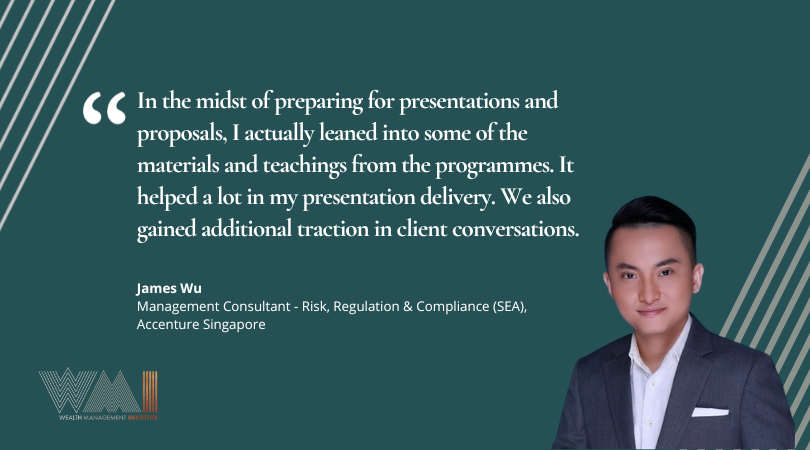
“In the midst of preparing for presentations and proposals, I was also able to lean into some of the materials and teachings from the programmes. It helped a lot in my presentation delivery. As a result of this, we also gained additional traction in client conversations.”

James has since taken on more impactful ventures and higher-stake projects at work, and he attributes his growth to his learning journey.

The sweet spot between work and upskilling

Staying committed to lifelong learning while dedicating oneself to work requires immense dedication and many of WMI’s participants do so to stay at the forefront of what they believe is essential.

In recognising the challenge of attending classes and studying whilst keeping up with the pressing demands of your full-time work, WMI’s Advanced Compliance Programmes are structured into modules of two to three days on average and spaced apart across several weeks to allow participants to upskill themselves while minimally disrupting their work commitments.

“The spaced-out format of the programme gave me the perfect balance as I was able to integrate my learning across several weeks and apply the knowledge gained,” attests James.

This programme equips students with the full range of skills and competencies across all the Compliance job families identified in the IBF National Skills Framework for Financial Services. The Graduate Diploma in Compliance empowers learners to master a comprehensive range of Compliance disciplines covering Regulatory Advisory, Financial Crimes Compliance, Compliance Analytics, Monitoring, Surveillance and Testing, and includes a Capstone project with industry mentoring to tackle real-life industry problems.

Graduates of the Graduate Diploma in Compliance in Financial Services programme will earn a WMI qualification and are eligible to apply for IBF Advanced certifications in the relevant Compliance job families.

Take your compliance career to the next level with WMI’s Advanced Compliance Programmes

Related Article

Philanthropy, ESG & Social Impact

The Rockefeller Family and Peking Union Medical College:
A Century of Philanthropic Impact
洛克菲勒家族与协和医学院:
跨越百年的公益影响力

Programme Overview


【Chinese version below| 请见下方中文内容。】


When family legacy is discussed, attention often centres on how wealth, business ownership and control can be transferred smoothly from one generation to the next.


For many families, however, legacy is not only about the assets they preserve. It is also about the long-term value they hope to create for society. Enduring family influence often comes from translating resources, values and purpose into institutions and initiatives that can evolve, endure and serve needs beyond the family itself.


The development of Peking Union Medical College (PUMC) offers a meaningful historical example.


In the early twentieth century, China was entering an important period in the development of modern medicine and public health. The China Medical Board was established in 1914 with support from the Rockefeller family’s philanthropic efforts to advance medical education, research and healthcare in China. PUMC was established in 1917 and received sustained support through the China Medical Board. In 1921, John D. Rockefeller Jr. travelled to Beijing to attend the dedication of the PUMC campus.


Over time, PUMC became an important institution in the development of modern medical education, medical research and clinical care in China. Its significance extended beyond the establishment of a medical school or hospital. It reflected a long-term commitment to developing professional talent, clinical capability, research capacity and institutional standards.


This approach also reflected an important Rockefeller philanthropic principle: philanthropy can be more than a one-time financial gift. It can be a sustained investment in long-term capability, professional excellence and institutions that create public value. The Rockefeller Foundation, established in 1913, focused its early work on areas including public health, medical research, education and agriculture. This more systematic approach to addressing social challenges later became associated with the idea of “scientific philanthropy”.


The Rockefeller experience emerged from a specific American historical and institutional context. It should not be treated as a model for Asian families to replicate.


Nevertheless, the story of PUMC raises questions that are increasingly relevant for families across Asia as they navigate significant intergenerational transitions.


How can the next generation inherit not only wealth, but also responsibility and purpose?


As a family grows larger and more diverse, what can sustain a shared sense of values?


Beyond wealth preservation and investment performance, what long-term contribution does the family hope to make?


For many families, philanthropy can provide a platform for shared learning, participation and decision-making. It enables different generations to engage with real social issues, work with specialist partners and translate family values into purposeful action.


This does not mean that every family needs to establish a large foundation or institution. Enduring philanthropic impact can take many forms: providing multi-year support to an education initiative, healthcare institution or mission-led nonprofit; or building long-term partnerships with universities, hospitals, community organisations and other trusted partners.


Assets can be transferred through legal documents.


Institutions must be built. Responsibility must be practised. Purpose must be understood, renewed and carried forward by successive generations.


The story of PUMC is a reminder that enduring family legacy is not only about preserving wealth. It is also about considering how wealth can be mobilised to create long-term public value.


Beyond transferring wealth, what responsibility, values and future does your family hope to carry forward?


Source note: This article was prepared with reference to the publication “Giving Across Generations: A Century of Rockefeller Family Philanthropy and Innovation”.


【English version above. 请见上方英文内容。】


当人们谈论家族传承时,焦点通常落在财富、企业股权与控制权如何在代际之间有序交接。


但对于许多家族而言,真正值得传承的或许不止是资产本身,也包括家族希望为社会创造怎样的长期价值。能够跨越时间的家族影响力,往往来自于将资源、价值观与使命,转化为可持续运作、不断发展,并服务更广泛社会需要的机构与事业。


北京协和医学院(Peking Union Medical College, PUMC)的发展,提供了一个值得思考的历史案例。


20世纪初,中国正处于现代医学与公共卫生发展的关键时期。1914年,中国医学委员会(China Medical Board)成立,并在洛克菲勒家族慈善事业支持下,推动中国医学教育、医学研究和医疗服务的发展。北京协和医学院于1917年成立,并获得中国医学委员会的长期支持。1921年,约翰·D·洛克菲勒二世(John D. Rockefeller Jr.)到访北京,出席协和医学院建筑群的落成典礼。


此后,协和医学院逐步发展为中国现代医学教育、医学研究和临床医疗体系中的重要机构。其意义不只在于建立一所医学院或医院,更在于长期支持专业人才培养、临床能力、医学研究与制度发展。


这也反映了洛克菲勒家族慈善理念中的一个重要取向:公益不只是一次性的捐赠,而可以是对长期能力、专业标准和公共机构的持续投入。洛克菲勒基金会于1913年成立,其早期工作聚焦公共卫生、医学研究、教育及农业等领域,并以更系统性的方式回应社会挑战。这一思路后来常被称为“科学慈善”(scientific philanthropy)。


当然,洛克菲勒家族的经验形成于特定的美国历史与制度环境,并不构成亚洲家族可以直接复制的模式。


但协和医学院的故事所提出的问题,对正经历大规模家族传承的亚洲家族具有现实意义:下一代如何不仅继承财富,也继承守护责任与公共使命?当家族成员不断增加、背景日益多元时,什么能够维系共同的价值认同?除了资产配置和财富保全,家族希望为社会留下怎样的长期贡献?


对许多家族而言,公益可以成为一个共同学习、共同参与和共同决策的平台。它让不同世代有机会围绕真实社会议题展开对话,与专业伙伴合作,并将家族价值观转化为具体行动。


这并不意味着每个家族都需要建立大型基金会或机构。长期公益影响力可以来自持续支持一个教育项目、一家医疗机构或一个具有明确使命的社会组织;也可以来自与大学、医院、非营利机构和社区伙伴建立长期合作。


财富可以通过法律文件完成交接。


但机构需要长期建设。责任需要持续实践。使命则需要一代又一代人不断理解、参与并赋予新的意义。


从协和医学院的发展历程中,我们看到:真正持久的家族传承,不仅在于守护财富,也在于思考财富如何成为推动长期公共价值的力量。


除了传承财富,家族希望传承怎样的责任、价值观与未来?


资料来源说明: 本文参考《跨越世代:洛克菲勒家族慈善事业的百年传承与创新》(Giving Across Generations: A Century of Rockefeller Family Philanthropy and Innovation)整理撰写。


Upcoming Dates

Modules

Download programme brochure

Who Should Attend

Useful Links

Certification

Participants who successfully complete the programme will be awarded: 

Modules Full Fees
(S$)
Before GST After GST Company-Sponsored
Modules Full Fees
(S$)
Before GST After GST Singaporean Aged Below 40 / PR Singaporean Aged 40 & Above
Modules Fees after Subsidy
(incl. of GST)
Category
2
S$34,920 S$47,520 S$85,020
1 Not Applicable
S$25,420 S$42,520 S$85,020


1 For Singaporeans aged 40 and above, you are eligible to utilise the SkillsFuture Credit (Mid-Career) further to offset your course fee after the IBF subsidy.

2 Fees shown are after IBF-STS funding assuming students meet the minimum academic standards outlined by IBF and are physically based in Singapore. The fees are also subject to IBF accreditation approval for all modules.


Modules
Full Fees
(S$)
Before GST After GST
Singaporean
Aged Below 40 / PR
Company Sponsored/Self Sponsored
Singaporean
Aged 40 & Above
Company Sponsored/Self Sponsored

Core Modules
Full Fees
(S$)
Before
GST
Singaporean
Aged Below 40 / PR
Singaporean
Aged 40 & Above
Company Sponsored/Self
Sponsored
Company Sponsored/Self
Sponsored

Note:

Schedule

Testimonials

Enquire Now

Masters Programme

Beyond the headlines: What it takes to stay grounded in volatile markets

Programme Overview

Upcoming Dates

Modules

Download programme brochure

Who Should Attend

Useful Links

Certification

Participants who successfully complete the programme will be awarded: 

Modules Full Fees
(S$)
Before GST After GST Company-Sponsored
Modules Full Fees
(S$)
Before GST After GST Singaporean Aged Below 40 / PR Singaporean Aged 40 & Above
Modules Fees after Subsidy
(incl. of GST)
Category
2
S$34,920 S$47,520 S$85,020
1 Not Applicable
S$25,420 S$42,520 S$85,020


1 For Singaporeans aged 40 and above, you are eligible to utilise the SkillsFuture Credit (Mid-Career) further to offset your course fee after the IBF subsidy.

2 Fees shown are after IBF-STS funding assuming students meet the minimum academic standards outlined by IBF and are physically based in Singapore. The fees are also subject to IBF accreditation approval for all modules.


Modules
Full Fees
(S$)
Before GST After GST
Singaporean
Aged Below 40 / PR
Company Sponsored/Self Sponsored
Singaporean
Aged 40 & Above
Company Sponsored/Self Sponsored

Core Modules
Full Fees
(S$)
Before
GST
Singaporean
Aged Below 40 / PR
Singaporean
Aged 40 & Above
Company Sponsored/Self
Sponsored
Company Sponsored/Self
Sponsored

Note:

Schedule

Testimonials

Enquire Now

Investing and Asset Management

Rethinking Diversification: Ray Dalio on the Mechanics of Building a Balanced Portfolio

Programme Overview

Upcoming Dates

Modules

Download programme brochure

Who Should Attend

Useful Links

Certification

Participants who successfully complete the programme will be awarded: 

Modules Full Fees
(S$)
Before GST After GST Company-Sponsored
Modules Full Fees
(S$)
Before GST After GST Singaporean Aged Below 40 / PR Singaporean Aged 40 & Above
Modules Fees after Subsidy
(incl. of GST)
Category
2
S$34,920 S$47,520 S$85,020
1 Not Applicable
S$25,420 S$42,520 S$85,020


1 For Singaporeans aged 40 and above, you are eligible to utilise the SkillsFuture Credit (Mid-Career) further to offset your course fee after the IBF subsidy.

2 Fees shown are after IBF-STS funding assuming students meet the minimum academic standards outlined by IBF and are physically based in Singapore. The fees are also subject to IBF accreditation approval for all modules.


Modules
Full Fees
(S$)
Before GST After GST
Singaporean
Aged Below 40 / PR
Company Sponsored/Self Sponsored
Singaporean
Aged 40 & Above
Company Sponsored/Self Sponsored

Core Modules
Full Fees
(S$)
Before
GST
Singaporean
Aged Below 40 / PR
Singaporean
Aged 40 & Above
Company Sponsored/Self
Sponsored
Company Sponsored/Self
Sponsored

Note:

Schedule

Testimonials

Enquire Now

Other Suggested Articles